
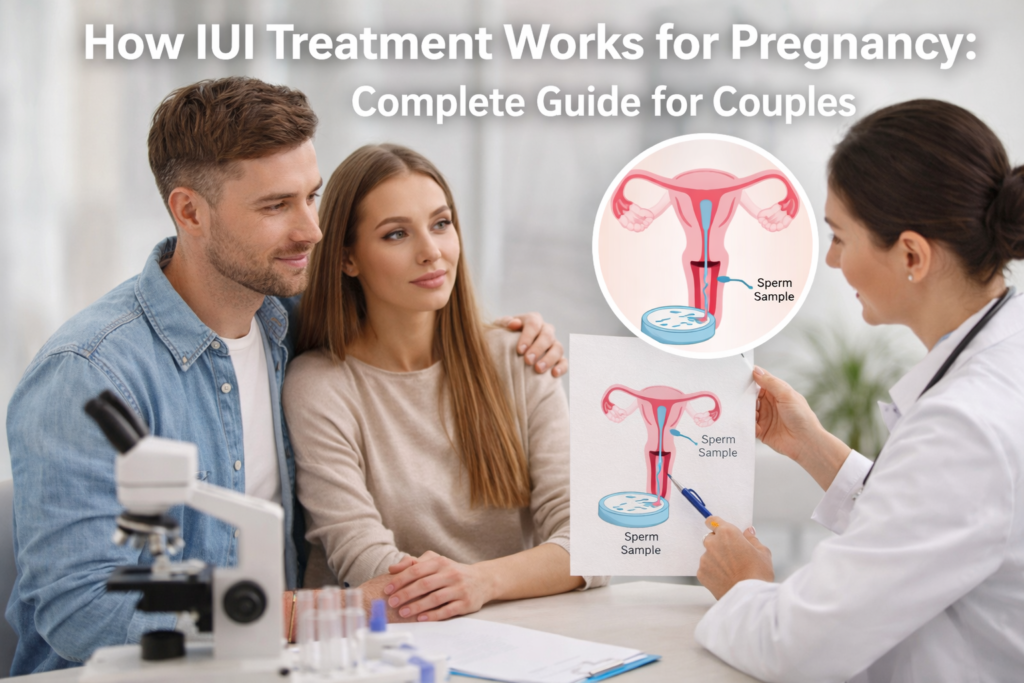
When couples face difficulty in conceiving, one of the most commonly recommended first-line fertility options is IUI. Many patients ask one important question: How IUI treatment works for pregnancy? Understanding how IUI treatment works can reduce anxiety and help couples make confident decisions about their fertility journey.
This detailed guide explains clearly how IUI treatment works, who should consider it, and what results to expect.
Understanding How IUI Treatment Works
To understand how IUI treatment works, it is important to first understand natural conception. In natural pregnancy, sperm must travel through the cervix, into the uterus, and then reach the fallopian tube where it meets the egg.
In some couples, this journey becomes difficult due to:
- Low sperm count
- Poor sperm motility
- Cervical mucus issues
- Ovulation problems
- Unexplained infertility
IUI improves this process by placing specially prepared sperm directly inside the uterus during ovulation. This is the foundation of how IUI treatment works — it reduces the distance sperm must travel and increases the number of active sperm reaching the egg.
Step-by-Step Explanation of How IUI Treatment Works
Many couples feel more confident once they understand step-by-step how IUI treatment works during the menstrual cycle.
Ovulation Stimulation
The process usually begins on Day 2 or Day 3 of the menstrual cycle. Fertility medications are prescribed to stimulate egg development. These medicines help the ovary produce a mature egg, improving fertilization chances.
Follicular Monitoring
Regular ultrasound scans monitor egg growth. When the follicle reaches optimal size (18–22 mm), it indicates readiness for ovulation. Careful monitoring plays a major role in how IUI treatment works successfully.
Trigger Injection
Once the egg matures, a trigger injection is given to induce ovulation. Ovulation typically occurs within 34–36 hours. Accurate timing is critical because precise scheduling is a key factor in how IUI treatment works effectively.
Sperm Preparation
On the scheduled day, the semen sample is collected and processed in the laboratory. Through sperm washing, healthy and fast-moving sperm are separated from weak sperm and impurities.
This preparation step significantly improves how IUI treatment works by ensuring only high-quality sperm are used.
Insemination Procedure
The prepared sperm are gently inserted into the uterus using a thin catheter. The procedure is simple, takes about 5–10 minutes, and does not require anesthesia or hospital admission.
Direct placement of sperm inside the uterus is the core reason how IUI treatment works better than natural attempts in selected infertility cases.
Who Should Consider IUI?
Doctors commonly recommend IUI for:
- Mild male infertility
- Unexplained infertility
- Irregular ovulation
- Cervical mucus problems
- Couples trying to conceive for 1–2 years
Proper patient selection is very important because choosing the right candidates determines how IUI treatment works successfully.
Success Rate and Factors Affecting Results
Another common concern is whether IUI guarantees pregnancy. While no fertility treatment guarantees 100% results, understanding how IUI treatment works helps set realistic expectations.
The success rate depends on:
- Woman’s age
- Egg quality
- Sperm quality
- Uterine health
- Correct timing
On average, success rates range from 10% to 20% per cycle. Younger women typically have higher success rates. Doctors may advise 2–3 cycles before moving to advanced options.
These medical factors directly influence how IUI treatment works in each individual case.
What Happens After the Procedure?
After insemination:
- The patient can resume normal activities
- Mild cramps may occur
- Prescribed medicines must be continued
A pregnancy test is usually done 14 days later.
The two-week waiting period can be emotionally challenging, but patience is important while observing how IUI treatment works within the body.
Why Early Evaluation Improves Outcomes
Many couples delay fertility consultation due to hesitation or lack of awareness. However, early diagnosis significantly improves treatment success.
Timely consultation allows doctors to:
- Identify the root cause of infertility
- Plan personalized treatment
- Optimize timing
Early medical intervention enhances how IUI treatment works and improves overall pregnancy chances.
Final Thoughts
Infertility can feel overwhelming, but medical science offers structured and effective solutions. Understanding clearly how this treatment works empowers couples to move forward with confidence.
With proper monitoring, accurate ovulation timing, laboratory sperm preparation, and expert medical supervision, IUI has helped many couples achieve successful pregnancies.
If you are facing difficulty conceiving, consulting a fertility specialist can help determine whether IUI is the right step in your parenthood journey.
Comments: